

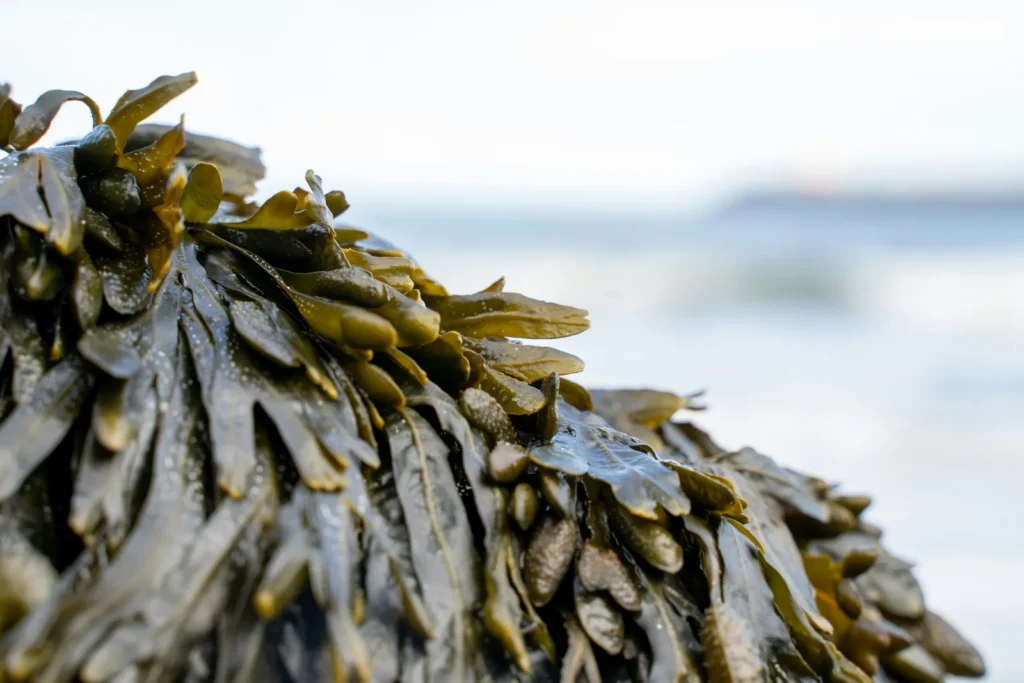
Seaweed extract is a plant biostimulant derived from marine algae, such as the brown seaweed Ascophyllum nodosum, that is applied to crops to improve nutrient use efficiency, strengthen tolerance to abiotic stress and support overall crop yield and quality. Unlike fertilisers, which supply nutrients directly, seaweed extract works by triggering the plant’s own physiological responses, which is why it is classed as a biostimulant rather than a plant food.
Where Seaweed Extract Comes From
Ascophyllum nodosum is an intertidal seaweed found only in the pristine waters of the North Atlantic. Growing between the changing tides exposes it to extreme conditions, from full submersion to direct sunshine and shoreline frost, and over time it has developed a unique biochemistry to survive this environment, including unique carbohydrates, more than 60 chelated elements, 21 amino acids and natural antioxidants. It is this evolved chemistry, rather than the seaweed itself, that gives the extract its effect on crops.
How the seaweed is harvested also matters. Responsible harvesters cut only the top of the seaweed while it is submerged, leaving the base to regrow and replenish within a two-year cycle, a practice recognised as the most sustainable method of seaweed harvesting currently available.
Why Extraction Method Changes the Result
Not all seaweed extracts behave the same way, even when they come from the same species and look identical in the jug. The extraction process, whether hot or cold, and whether run at an alkaline or neutral pH, changes the concentration and molecular size of bioactive carbohydrates such as alginate, fucoidan and laminarin in the final product, and that profile is what determines how the extract performs in the field.
This was demonstrated directly in a Brandon Bioscience drought trial comparing three Ascophyllum nodosum extracts produced by different manufacturing methods. The extract produced through a high-temperature, aqueous neutral pH process outperformed the two alkaline high-temperature extracts on almost every measure, including an eight-fold increase in the drought-response dehydrin gene tas14 compared with a 290% and 205% increase for the other two extracts, alongside increased leaf proline content, better chlorophyll retention and higher relative water content under stress. In other words, two products can both legitimately be labelled seaweed extract and still deliver meaningfully different results, which is why the manufacturing process is worth asking suppliers about directly.
How Seaweed Extract Works Once Applied
Seaweed extract does not act as a single mechanism. Depending on the formulation and how it is engineered, it can influence a plant in several distinct ways:
- Nutrient use efficiency: by stimulating the plant’s own uptake and assimilation pathways for macro- and micronutrients.
- Abiotic stress tolerance: by triggering the accumulation of protective metabolites, such as osmolytes and antioxidant compounds, and protective proteins such as heat shock proteins (HSPs), and by improving sugar and nutrient transport to flowers and fruits under conditions such as high temperature, drought or salinity.
- Crop quality: by improving markers such as °Brix (sugar content) and crop size, which influence marketability, buyer acceptance, and grower returns.
We cover the underlying stress-response mechanisms in more depth in our article on climate change and abiotic stresses in plants, and the crop quality angle specifically in boosting crop quality with seaweed biostimulants.
What the Field Data Shows
Brandon Bioscience’s PSI® Technology products have been tested extensively across commercial trial programmes. BARRAMAR®, designed to secure crop yield and quality by enhancing nutrient use efficiency and protecting against abiotic stresses, has been evaluated in 234 field, glasshouse, and growth room trials between 2009 and 2024. Across these trials, it delivered an average yield increase of 20.3% with a 90% positive response rate, alongside improvements in °Brix (up to 20%) and crop size (ranging from 7.2% to 63.5%, depending on the crop species). Separately, PSI®362, a nitrogen-focused Ascophyllum nodosum biostimulant, improved nitrogen use efficiency by 22% to 33% across 59 field trials while allowing up to a 25% cut in nitrogen fertiliser without a yield penalty.
Common Uses of Seaweed Extract in Agriculture
In practice, seaweed extract is applied to solve a fairly specific set of recurring problems on farm, rather than as a blanket treatment. The most common applications include:
- Reducing nitrogen and other fertiliser inputs while maintaining yield, by improving the plant’s own nutrient uptake and assimilation efficiency.
- Protecting yield and quality in crops irrigated with saline or poor-quality water, by supporting osmotic balance and limiting sodium uptake.
- Maintaining fruit set and pollen viability through heat waves during flowering, a stage that is otherwise highly vulnerable to temperature stress.
- Improving water use efficiency in drought-prone or deficit-irrigated systems, reducing the yield penalty of using less water.
The common thread across all four uses is that seaweed extract is being asked to help the plant perform better under a specific constraint, whether that is a limited nutrient budget, poor water quality, heat or drought, rather than being used as a general substitute for good agronomy.
Is Seaweed Extract Suitable for Organic Farming?
Many seaweed extract biostimulants are suitable for use in organic farming, including several products in Brandon Bioscience’s own range. The wording that applies depends on the product and the market. Products controlled by ECOCERT SAS are suitable for use in Organic Farming in accordance with Regulations (EU) No 2018/848 and 2021/1165. In the United States, products that are OMRI Listed are suitable for use in organic production according to the USDA National Organic Program regulations. In Spain, products controlled by CAAE are authorized in organic farming in accordance with the Standard UNE 142500. Because seaweed extract works by modulating the plant’s own physiological responses rather than supplying synthetic nutrients directly, it fits comfortably within organic farming systems, though growers should always check the documentation for the specific product and country rather than assuming all seaweed-derived inputs qualify automatically.
Not All Seaweed Extracts Are Equal
Because seaweed extract covers such a broad category of products, from raw dried seaweed meal to precision-engineered liquid extracts, quality and consistency vary enormously between suppliers. Buyers evaluating options should look closely at the raw material source, the extraction method, and whether the supplier can show trial data rather than composition figures alone. We break this down in detail in 5 key factors that differentiate seaweed extract biostimulants, and trace how the category has developed in the evolution of seaweed extract in agriculture.
Getting Started With Seaweed Extract
For growers considering seaweed extract for the first time, the most useful starting point is identifying the specific challenge it needs to solve, whether that is nutrient cost, water stress, salinity or fruit quality, since the extraction method and formulation best suited to each of those problems differ. Our solutions overview maps our own product range against these challenges, and our team is happy to talk through which approach fits your crop and growing region if you get in touch.
Frequently Asked Questions
Is seaweed extract the same as fertiliser?
No. Fertiliser supplies nutrients directly to the plant, whereas seaweed extract works as a biostimulant, triggering the plant’s own nutrient use efficiency and abiotic stress tolerance mechanisms. The two are typically used alongside each other rather than as substitutes, and several precision-engineered extracts, including PSI®362, are specifically designed to be co-applied with nitrogen fertilisers to improve nitrogen uptake and assimilation.
How quickly does seaweed extract work?
This depends on the application method and formulation. Foliar applications aimed at improving nutrient use efficiency or enhancing abiotic stress tolerance can typically induce measurable changes in gene expression within a few hours of application. Physiological and metabolic responses, such as changes in relative water content, oxidative stress markers, or tissue nutrient concentrations, are often observed within 3 to 7 days. Phenotypic effects generally become visible after 7 to 15 days, while impacts on yield and crop quality are typically assessed at harvest.
Can seaweed extract replace irrigation or fertiliser entirely?
No. It improves the efficiency with which a crop uses the water and nutrients it is given, which allows for reduced input rates in some cases, but it does not remove the underlying requirement for water and nutrients altogether.