

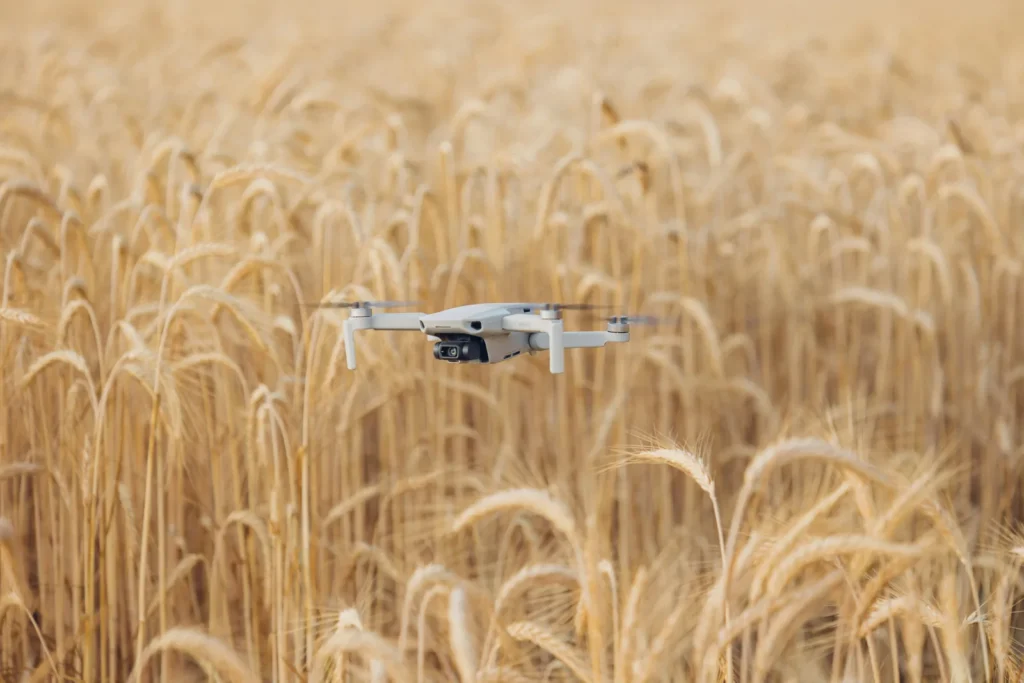
Improving crop yield with technology today means combining two layers that work together rather than any single tool on its own:
- Precision agriculture systems that tell growers exactly where and when to act.
- Precision-engineered biostimulants that help crops use inputs more efficiently and cope with stress.
Below, we walk through each layer with real trial data, and where to start if you are looking to apply this to your own fields.
It is worth clarifying why yield stalls in the first place before looking at the fixes. In most cases, yield is capped by one of two constraints: a resource limitation such as water or nitrogen, or an environmental stress such as heat or salinity at a critical growth stage. Technology helps most when it is matched to the specific constraint actually limiting a field, rather than applied generically, which is why the two layers below are presented as a diagnostic framework as much as a shopping list.
Layer One: Precision Agriculture Systems
Precision agriculture is the most visible form of farming technology: GPS-guided machinery, soil and canopy sensors, satellite and drone imagery, and the data analytics platforms that turn all of that into a decision. Instead of applying water, fertiliser or crop protection uniformly across a field, precision systems identify the zones that actually need intervention, which reduces waste and protects yield potential in the areas that respond best to input.
This layer is well covered in our dedicated article on agricultural precision farming technology, which looks at the tools currently being adopted across different farm sizes and crop types.
The main value of this layer is diagnostic. Before spending on any other technology, precision agriculture data tells you whether your yield ceiling is being set by water, nutrient availability, pest pressure or something structural such as soil compaction in specific zones, so the next investment can be targeted rather than guessed at.
Layer Two: Precision-Engineered Biostimulants
The least visible but arguably most impactful layer is biostimulant technology purpose-built around a specific agronomic challenge. Brandon Bioscience’s PSI® Technology platform validates each biostimulant chemically, biologically and functionally, so its mode of action in the crop is understood rather than assumed. Three examples illustrate how this translates into yield:
- BARRAMAR®, designed to secure crop yield and quality by enhancing nutrient use efficiency and protecting against abiotic stresses, delivered an average yield increase of 20.3% with a 90% positive response rate across 234 field, glasshouse and growth room trials run between 2009 and 2024, alongside improvements in °Brix (up to 20%) and crop size (from 7.2% to 63.5%, depending on the crop species).
- MARTELLO®, built to maximise yield and quality under prolonged abiotic stress by building tolerance to heat, salinity and drought, returned a 15.1% yield advantage with an 85% positive response rate across 99 trials over 14 years, driven by improved pollen viability and fruit set under heat-stressed conditions.
- PSI®362, focused on nitrogen, improved nitrogen use efficiency (NUE) by 22% to 33% across 59 field trials while allowing up to a 25% cut in nitrogen fertiliser without a yield penalty, and lifted grass dry matter yield by 29% under a reduced nitrogen regime.
What separates precision-engineered biostimulants from generic seaweed extracts sold on composition alone is that each product in the PSI® range is designed and validated against one defined agronomic problem, whether that is nitrogen efficiency, salinity or heat stress, rather than marketed as a general-purpose crop tonic. That specificity is what makes the trial data above reproducible across seasons, rather than anecdotal.
Measuring Whether the Technology Is Actually Working
Because each of these two layers works through a different mechanism, they need different measurements to prove their value. Precision agriculture ROI shows up fastest in input cost per hectare, since the savings from targeted rather than blanket application are visible within a single season. Biostimulant ROI is most reliably measured against a true untreated control strip in the same field and season, since year-on-year comparisons are too easily confounded by weather. Growers who skip this step often underestimate the return on biostimulant technology simply because they never isolated it from everything else that changed that season.
Why Technology Layers Matter More Than Any Single Tool
Growers sometimes treat precision agriculture and biostimulants as competing options, but the data suggests they are complementary rather than substitutable. Precision agriculture tells you where the yield-limiting factor is. Biostimulant technology then protects that yield potential through the stresses, whether nutrient, water or temperature related, that would otherwise erode it before harvest.
This layered view is also how we approach the broader question of crop yield on our main resource, key farming problems affecting crop yield and ways to improve it, which covers the agronomic fundamentals alongside the technology side covered here.
Where to Start
If budget only allows one intervention this season, the starting point depends on where the biggest constraint currently sits:
- If input costs, particularly nitrogen, are the pressure point, a precision-engineered biostimulant such as PSI®362 offers a measurable return without requiring new machinery.
- If water availability is the constraint, look at irrigation scheduling technology alongside a water-use-efficiency biostimulant.
- If yield variability within fields is the issue, precision agriculture mapping and variable-rate application will typically show the clearest return.
For a conversation about which layer would move the needle most on your specific crop and region, contact our technical team.
A Note on Stacking Technologies Across Seasons
One pattern that shows up consistently in multi-year trial data is that the layers described here compound rather than simply add up. A field that has been under precision agriculture management for several seasons typically has better baseline data, which makes it easier to target a biostimulant programme precisely rather than applying it uniformly. Growers who expect a single season of technology adoption to fully demonstrate the case for continuing it are often disappointed, not because the technology failed, but because one season rarely isolates its effect cleanly from everything else happening in the field. Building a simple, consistent measurement habit from the first season, even something as basic as an untreated control strip, pays for itself many times over in the confidence it gives for scaling the following year.